Online Classes · Worldwide

Rishikesh, In Your Own Room.

Live one-to-one lessons with the same teacher, the same method and the same patience as a class at Laxman Jhula — carried over video to wherever you happen to live. Scheduled around your time zone, not ours.

About Online Study

An Old Method, A New Wire.

Indian classical music was never taught from a book. It was taught by ear, one person at a time — and that is precisely why it travels down a video call better than most subjects.

The traditional method is simple and it has not changed. The guru plays or sings a phrase. The student repeats it. The teacher listens, corrects one small thing, and asks for it again. That loop is the whole pedagogy, and it needs only two things to work: a teacher who is genuinely listening, and a student who is genuinely trying. Neither requires being in the same room.

What you lose online is real but smaller than people expect — the resonance of two instruments sounding in one space, and the ability of a teacher to physically move your hand. What you keep is everything that matters most: correction of pitch, correction of rhythm, phrase-by-phrase transmission, and the accumulated attention of a teacher who has only you to think about for the hour.

These are not recorded videos and there is no course platform to log into. Every session is live, one-to-one, and shaped by what you played the week before. If you arrive having practised, we go forward. If you arrive having struggled, we spend the hour on the thing that was hard.

“A screen cannot hide an out-of-tune note. Everything a teacher must hear still arrives.”

Teaching principle at Rishikesh Music Class
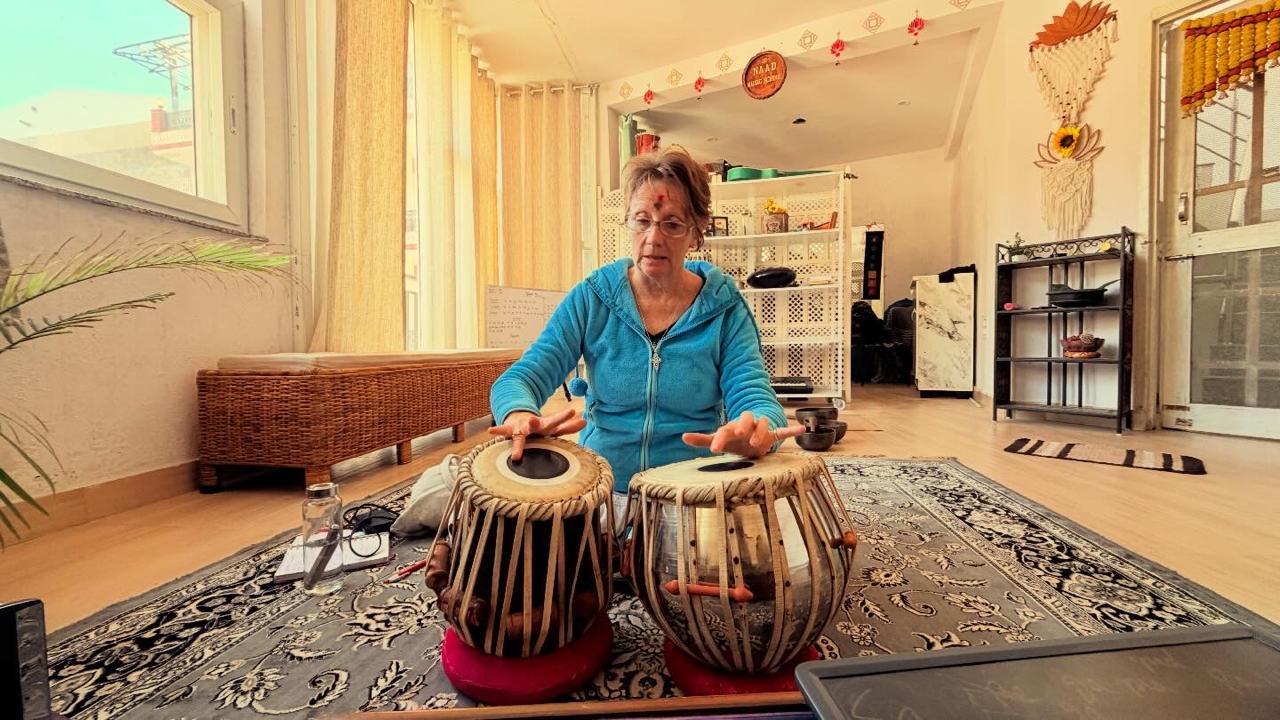
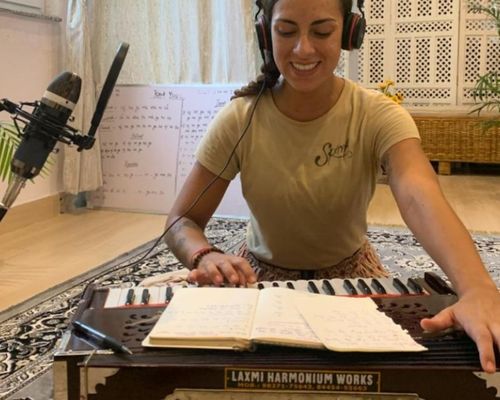
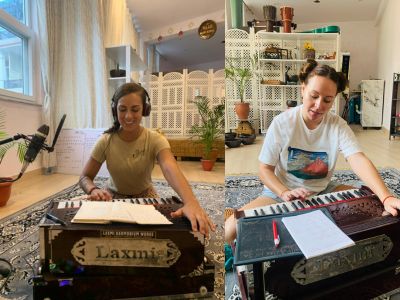
Live online Indian classical music lesson taught from Rishikesh
Taught live from Laxman Jhula, Rishikesh
1:1Always
How a Session Runs

One Hour, Six Familiar Stages.

No two students receive the same lesson, because it depends on your subject and on what you managed to practise. What stays constant is the shape of the hour — and that shape is what keeps progress steady when nobody is standing over you between classes.

1

Tuning and settling

A few minutes to check sound levels, tune your instrument to the tanpura or reference pitch, and let the room go quiet. Rushing this costs more time than it saves.

2

Warm-up

Long tones for flute and voice, open strokes for tabla, scale patterns for harmonium. The same warm-up every week, so you can hear your own improvement in it.

3

Review of your practice

You play what you were given last time. This is where most of the teaching happens — one correction at a time, repeated until it is right rather than until the clock moves on.

4

New material

A new phrase, composition, stroke pattern or raga movement, demonstrated slowly, then copied back until the shape is secure at a slow tempo.

5

Playing together

Teacher and student play the same thing at the same time, which is the fastest way to absorb phrasing and timing. Slight audio delay is normal and we work with it rather than against it.

6

Written practice plan

Every class closes with a written instruction sent on WhatsApp — exactly what to practise, how slowly, and for how long. Nobody should finish a lesson unsure what to do next.

60Minutes per class
6Daily time slots
1–2Hours riyaz
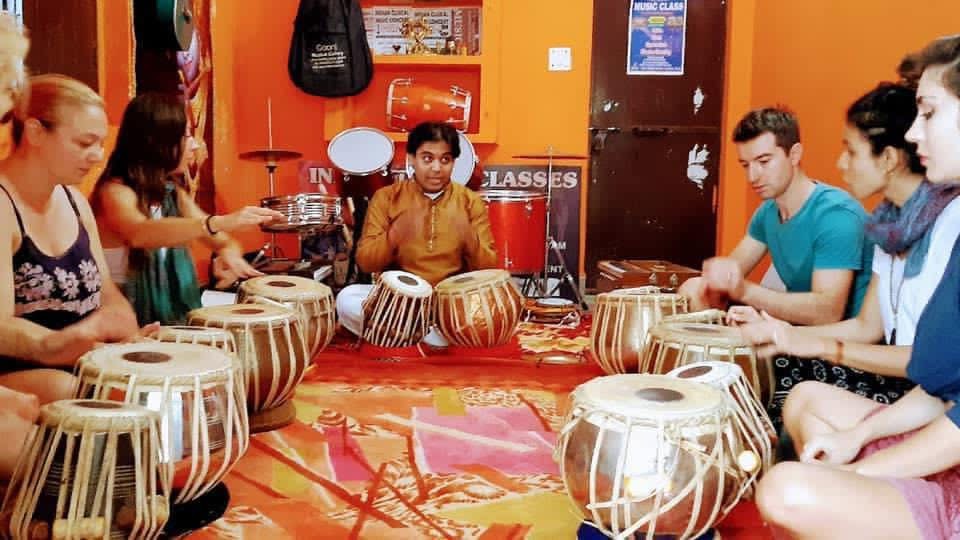
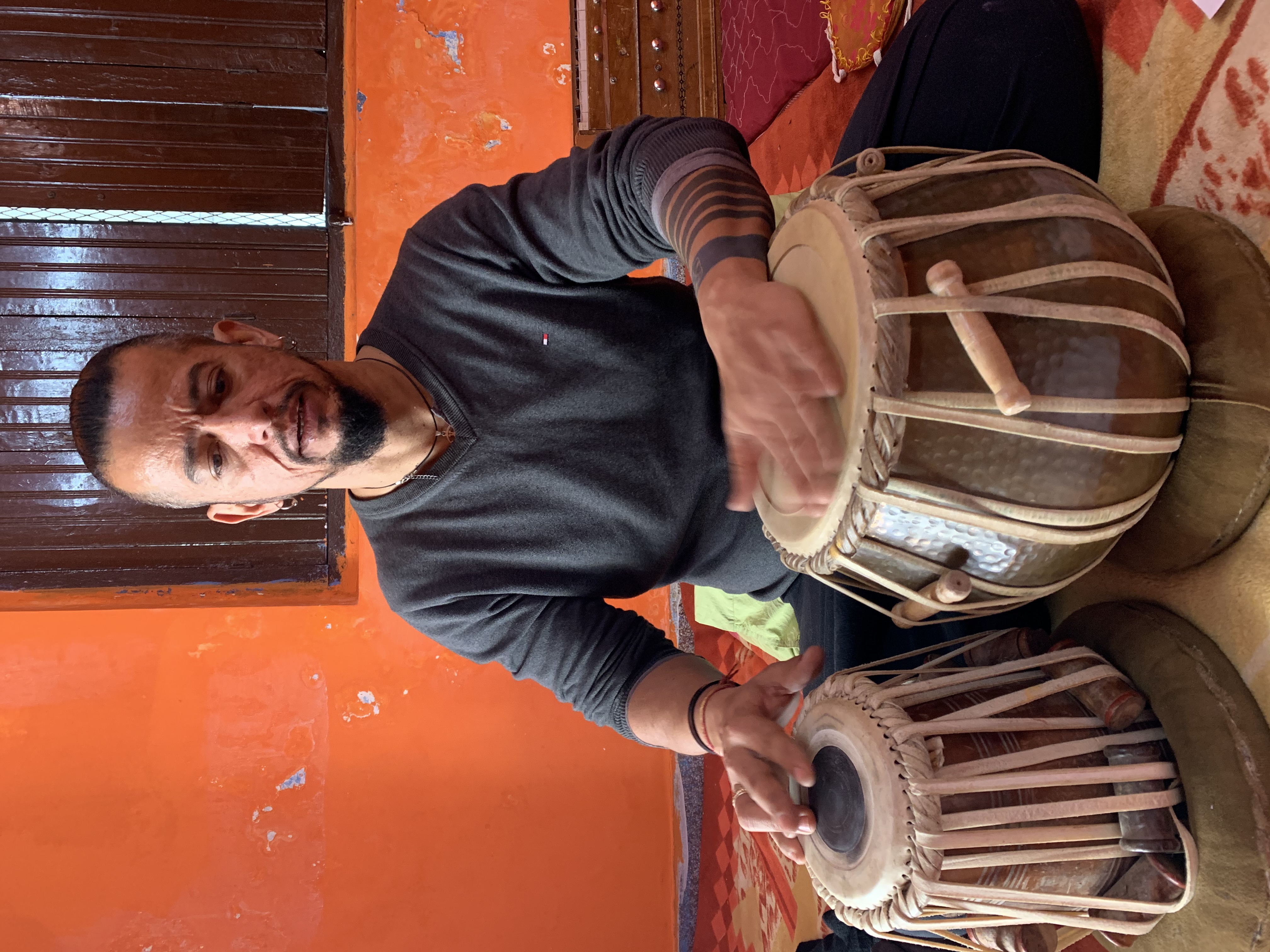
One-to-one music lesson in progress at Rishikesh Music Class
One student, one guru, one hour of full attention
30Max sessions
What You Can Study

Eight Subjects, All Taught Live.

Every course the school teaches in Rishikesh is also available online, with the same syllabus and the same one-to-one format. Some subjects suit video especially well — voice, raga and kirtan need nothing but your own instrument or breath.

Before Your First Class

Four Things, And Nothing Else.

There is no software to buy, no platform subscription and no equipment beyond what you almost certainly already own. If anything here is a problem, tell us — it is usually solvable.

☼

A quiet room

The single biggest factor in a good online lesson. A closed door matters more than an expensive microphone — background noise makes it hard for the teacher to hear the detail that needs correcting.

☁

A steady connection

Ordinary home broadband or decent mobile data is enough. Wired or close to the router is better than a weak wi-fi corner, particularly for tabla, where timing is everything.

♫

Your instrument

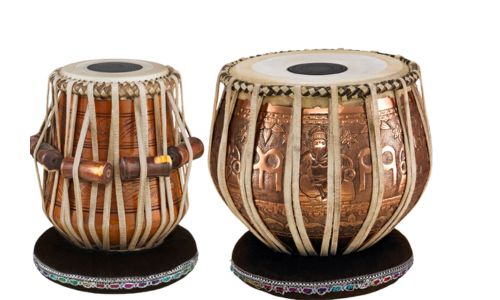
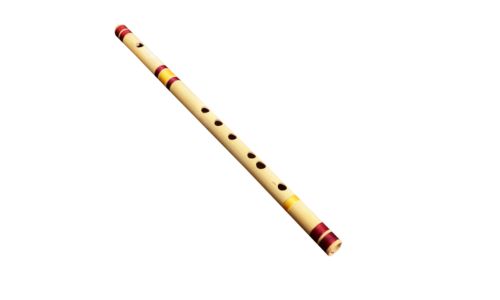
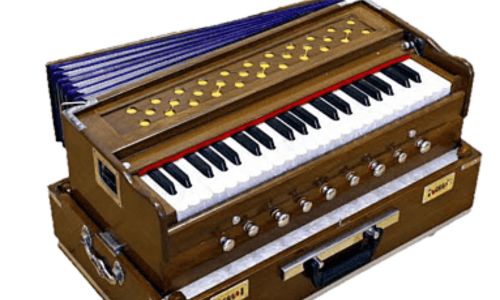
Tabla, bansuri or harmonium students play on their own instrument at home. Voice, kirtan, mantra and naad yoga students need nothing. Ask us before buying anything — pitch and quality matter.

☉

Somewhere to sit

A floor cushion or a firm chair, with your device propped so the teacher can see your hands, your posture and your instrument at the same time. Phone, tablet or laptop all work.

A Word on Headphones

Use Speakers, Not Earbuds

This is the one piece of technical advice that changes a lesson noticeably. Wireless earbuds add a delay of their own and often apply noise processing that treats musical sound as unwanted — flattening a tanpura drone, cutting the tail of a resonating stroke, or muting you while you are playing quietly.

Wired headphones are fine. Your device's own speakers are fine. If your app offers a setting such as original sound, high-fidelity audio or music mode, switch it on before the first class and leave it on. We will check this together at the start and it takes about a minute.

Scheduling

We Work Around Your Clock.

The school runs six slots a day in Indian Standard Time. You keep one fixed slot for the whole course, chosen to fall at a civilised hour where you actually live. Here is how the earliest and latest slots land around the world.

Where you are 9:30 AM IST slot 5:30 PM IST slot Usually best
London4:00 AM12:00 noonAfternoon & evening IST
Berlin · Paris · Madrid5:00 AM1:00 PMAfternoon & evening IST
Moscow7:00 AM3:00 PMAny slot
Dubai8:00 AM4:00 PMAny slot
New York · Toronto11:00 PM, previous day7:00 AMEvening IST
Chicago10:00 PM, previous day6:00 AMEvening IST
Los Angeles · Vancouver8:00 PM, previous day4:00 AMEvening IST
Singapore · Hong Kong12:00 noon8:00 PMMorning IST
Tokyo · Seoul1:00 PM9:00 PMMorning IST
Sydney2:00 PM10:00 PMMorning IST

India does not observe daylight saving time, so if your country does, shift these figures by one hour during your summer. We confirm the exact local time with you in writing before the first class.

ॐ

Morning slots

9:30 – 10:30 AM IST

11:00 AM – 12:00 PM IST

Comfortable for Asia, Australia and New Zealand. The traditional hour for riyaz, and the time most ragas of the early day belong to.

ॐ

Midday slots

12:30 – 1:30 PM IST

2:00 – 3:00 PM IST

Suits the Gulf, Russia and early risers in Europe. Often the quietest slots to book at short notice.

ॐ

Evening slots

4:00 – 5:00 PM IST

5:30 – 6:30 PM IST

The usual choice for Europe, the UK and the Americas. These fill first, so book early if you need one.

Course Options

Choose the Depth, Not Just the Dates.

Online courses use the same four lengths as classes in Rishikesh. Because there is no travel involved, most online students spread their sessions over weeks rather than days — one or two classes a week, with real practice time in between. That rhythm suits learning at home better than an intensive block.

07

Seven sessions — Introduction

Enough to find out whether the instrument and the method suit you. Clean tone or clean strokes, correct posture, your first patterns, and a practice plan you can continue alone.

10

Ten sessions — Foundation

The most popular choice. Secure fundamentals, your first complete composition from memory, and enough command that practising on your own stops being guesswork.

15

Fifteen sessions — Skill development

The stage where technique stops being the obstacle. Additional taals or ragas, faster tempos, cleaner ornamentation, and noticeably more confidence.

30

Thirty sessions — Intensive training

Genuine depth over several months. Substantial repertoire, improvisation, accompaniment practice, and a certificate on completion.

Fees are the same as in Rishikesh. Online sessions are priced identically to in-person classes and charged per course rather than per month. Current fees for all four lengths are on the fees and payment page.

Not sure which to take? Start with seven. It is deliberately short so that nobody commits a large sum to an instrument they have not yet held, and it converts naturally into a longer course if you want to continue.

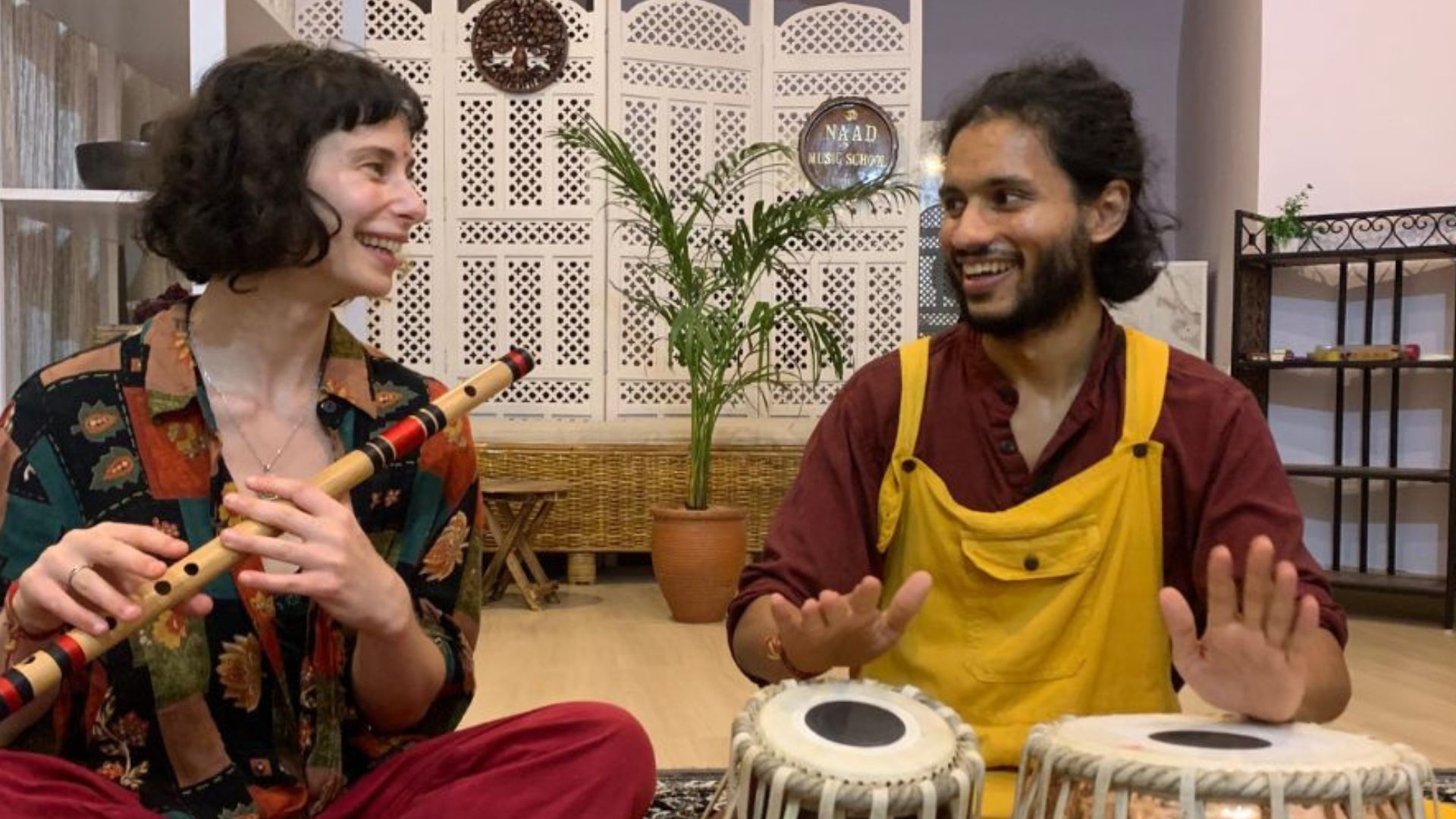
Indian classical music practice at Rishikesh Music Class
Four lengths, one honest price each
4Course lengths
An Honest Comparison

What Online Gives You, And What It Cannot.

We would rather you arrived with accurate expectations than be talked into the wrong format. Both work. They are simply good at different things, and for most people the deciding factor is practical rather than musical.

Online suits you if…

Learning from home
  • You cannot travel to India, or not yet.
  • You want to learn steadily over months rather than in one intensive block.
  • You already own an instrument, or your subject needs none at all.
  • You want continuity — many students carry on online after studying in Rishikesh in person.
  • You would rather test the method for seven sessions before committing to a trip.
  • You need a fixed weekly slot that fits around work or family.

What a screen cannot carry

Honest limitations
  • Two instruments cannot truly sound together in one acoustic space — small audio delay is unavoidable on any app.
  • A teacher cannot physically adjust your hand position, so corrections are described and demonstrated instead.
  • Very fast tabla accompaniment is harder to teach over a connection, and we build up to it more gradually.
  • You miss the surrounding context — the river, the ashram, the other students, the evening aarti.
  • You are responsible for your own practice discipline, with nobody nearby to keep you honest.

Many students do both — a block of intensive sessions in Rishikesh to establish the fundamentals properly, then online lessons from home to keep the thread from breaking. If that sounds right, say so when you write and we will plan the two halves together.

Getting Started

From Message to First Class.

There is no sign-up, no account and no payment required to ask. Four steps, and the first three cost nothing.

1

You send a message

Use the form further down or write on WhatsApp. Tell us the subject, your country and roughly when you would like to start. We reply personally, usually within a few hours.

2

We agree a time slot

We work out which IST slot lands at a sensible hour where you live and hold it for you. Nothing is charged at this stage and you are free to change your mind.

3

A short trial call

A brief video call before you pay for anything — we check your sound, your camera angle and your instrument, and answer whatever you want to ask. No obligation to continue.

4

Pay and begin

Once you are happy, send the course fee by bank transfer or PayPal. The link for your first class arrives before it starts, and the teaching begins.

Full fees, bank details and PayPal details are on the fees and payment page. We never ask for card numbers, passwords or OTPs — not by WhatsApp, not by email.

Common Questions

Asked Before Every First Class.

If your question is not here, send it on WhatsApp. We would rather answer twenty questions than have someone book the wrong course.

Can Indian classical music really be taught over video?

Yes, and it is less of a compromise than most people assume. This music has always been transmitted by ear rather than from notation — the teacher plays a phrase, you repeat it, the teacher corrects one thing. Video carries that exchange faithfully.

Rhythm subjects are the most demanding, because tabla depends on precise timing and every connection adds a little delay. We work around it by playing in turn rather than strictly together at speed, and by building tempo gradually. Voice, raga studies, kirtan and naad yoga lose almost nothing online.

Which app do you use, and do I need to buy anything?

Zoom, Google Meet or WhatsApp video — whichever proves most reliable on your connection. We send the link before each class. Nothing needs to be purchased, and no account is required on your side beyond the free version of whichever app we settle on.

How do you handle time zones?

Lessons are scheduled around your local time rather than ours. The school runs six slots a day in Indian Standard Time and we work backwards from whichever hour suits your day, then keep that slot fixed for the whole course.

In practice, students in Europe and the Americas take an afternoon or evening IST slot, and students in East Asia and Australia take a morning one. India does not observe daylight saving, so if your country does, the local time shifts by an hour in your summer — we confirm the change with you in writing rather than letting you find out by missing a class.

Do I need my own instrument?

For tabla, bansuri and harmonium, yes — you play on your own instrument at home. For voice training, kirtan, mantra chanting and naad yoga you need nothing at all.

Please ask before you buy. Bansuri in particular is sold in many pitches and beginners routinely buy one that is too long for their hands, then conclude they have no aptitude. A short message saves that. We will tell you what to look for and roughly what it should cost in your country, and we have no financial interest in what you choose.

Is it the same teacher as the classes in Rishikesh?

Yes. Online classes are taught by Amresh Kumar from the school at Laxman Jhula — the same method, the same written practice plans, the same one-to-one format. There are no assistants and no pre-recorded material.

What if I miss a class, or my internet fails mid-lesson?

Tell us in advance and the session is moved rather than lost. If a connection drops during a class we reconnect; if it cannot be recovered, the remaining time is added to your next session. We do not charge anyone for a lesson the technology prevented.

How much should I practise between classes?

One to two hours a day if you can manage it, but consistency matters far more than duration. Twenty focused minutes every day will take you further than three hours once a week — the hands and the ear both learn by repetition spread over time.

Every class ends with a written plan stating exactly what to practise and how slowly, so you never have to guess what the hour should contain.

Do you teach children, and complete beginners?

Complete beginners, yes — most subjects assume no experience whatsoever. Raga studies is the exception, as it expects you to already play or sing at an intermediate level.

Children are welcome from about eight years old, though online lessons with young children work best when a parent sits in for the first few classes to help with the device and the practice routine.

In which language are classes taught?

English or Hindi. Musical terms are taught in their original Sanskrit or Hindi form — sur, laya, taal, bol, alap — because those words carry meaning that translation loses, but they are always explained plainly in English first.

Beginning with Shree Ganesha

Every Course Opens With Sound

॥॥ वक्रतुंड महाकाय
सूर्यकोटि समप्रभ।
निर्विघ्नं कुरु मे देव
सर्वकार्येषु सर्वदा ॥॥
ॐ गं गणपतये नमः

Before the first phrase is played, students and guru chant together. It is a short moment, but it settles the room and marks the class as something separate from the day around it — clarity, confidence and the removal of obstacles before learning begins.

Course Guided By

Amresh Kumar

Indian classical music and Naad training at Rishikesh Music Class, Laxman Jhula, Rishikesh. Trained in the traditional lineage, with years of experience teaching students from across the world — both at the school and over video.

  • One-to-one guidance throughout the course.
  • Traditional Naad and guru–shishya method.
  • Patient correction, structured practice plans.
  • Long experience teaching international students.
  • Classes conducted in English and Hindi.
Good to Know

Please Note

Online courses are live, not recorded. There is no video library, no app and no self-paced material. Every session is taught in person over video at a time arranged with you, which is why places in the popular evening slots are limited.

Your practice is your own responsibility. Nobody is in the room between classes. Students who set aside a fixed practice hour progress; students who practise only before a lesson generally do not, and we will tell you so honestly rather than take the fee quietly.

If you later travel to Rishikesh, your online study continues seamlessly — same teacher, same plan, simply in the same room at last. Many students structure their learning exactly that way.

Book Your Sessions

Ready to Start Online Classes?

Send the short form across and it opens directly in WhatsApp with your details already written out. We reply personally — usually within a few hours — with the slots that fall at a sensible hour in your country, the current fee for your chosen course, and a suggested start date.

  • No payment or card details required to enquire.
  • Short trial call before you pay for anything.
  • Your time slot confirmed in writing, in your local time.
  • Same teacher and method as classes in Rishikesh.

Online Class Inquiry

Takes under a minute to fill.

Opens in WhatsApp with your details filled in.
Nothing is stored on this website.